

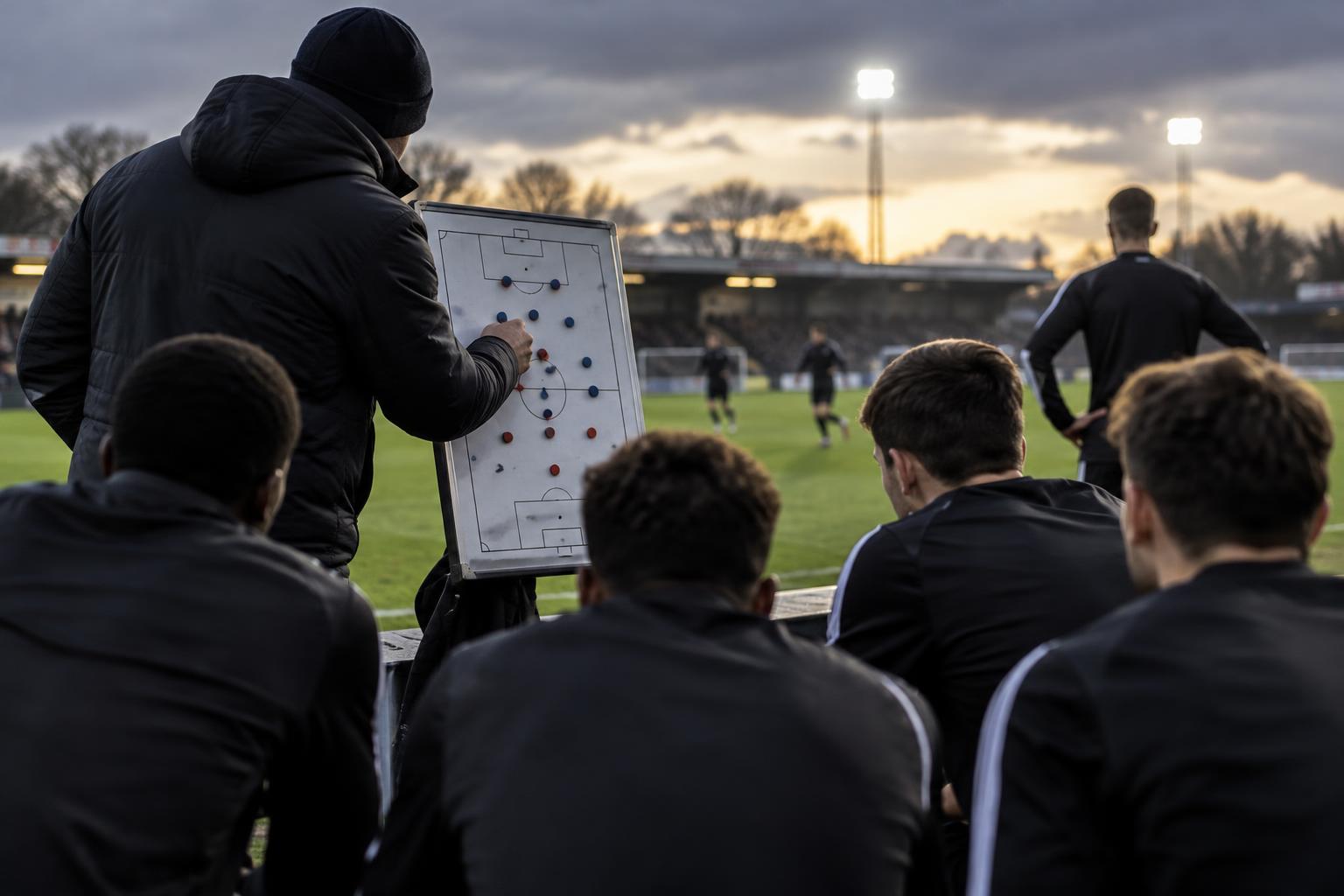
Learn how to play a 3-4-3 formation, from wing-back movement and attacking patterns to pressing, defensive cover and practical training ideas.
To play a 3-4-3 formation, set up with three centre-backs, two central midfielders, two wing-backs and three forwards. In possession, use the wing-backs to stretch the pitch while the midfield pair connect defence to attack; without the ball, recover into a 5-2-3 or 5-4-1. The key is coordinated movement: when someone advances, a team-mate must protect the space they leave. It is not simply a case of picking an extra centre-back and telling everyone else to attack. Done well, the system gives you width, close combinations around the striker and a solid defensive platform.
Setting up a 3-4-3: choose the right roles
 Advertisement · 18+ · Gamble responsibly · BeGambleAware.org
Start with the wing-backs, because their workload shapes everything else. They need the fitness to support attacks and recover into defence, plus the judgement to know when to do each. Your outside centre-backs should be comfortable defending the channels behind them and carrying or passing the ball forwards. The central defender provides cover and helps organise the line. In midfield, the double pivot, your central pair, must offer passing options without abandoning defensive protection. A goalkeeper comfortable on the ball also helps your team circulate possession rather than forcing the first forward pass available.
Next, decide how your front three will operate. With two narrow number 10s behind a centre-forward, often called a 3-4-2-1, the wing-backs supply the width while the attackers combine between the opposition’s midfield and defence. Those supporting forwards can occupy the half-spaces: the lanes between the centre and the touchlines. Alternatively, use wider forwards to attack opposition full-backs directly, with wing-backs supporting underneath them. Choose according to your players rather than treating one version as compulsory. A striker who can hold the ball up helps either approach by giving team-mates time to join attacks.
Attacking patterns in a 3-4-3 formation
Build through the back three and give the player on the ball options both inside and outside. The midfield pair should make themselves available to receive, switch play or find a forward between the lines. If an outside centre-back has space, encourage them to carry forwards rather than pass sideways automatically: drawing an opponent towards the ball can free a team-mate further ahead. Keep cover behind that movement. Your midfielders are connectors, not spectators, but sending both charging beyond the ball can leave the defence exposed. The aim is to move opponents out of position, not collect possession for its own sake.
Out wide, coordinate the wing-back with the nearest forward. With a narrow attacker, use an overlap to reach crossing or cut-back positions; with a winger holding the touchline, support behind them or make a delayed underlap through the inside channel. Avoid having both players stand in the same lane asking for the same pass. A useful pattern to rehearse is centre-back to midfield, midfield into a supporting forward, then a release for the advancing wing-back. Switch to the opposite flank if that side becomes crowded. The front three and wing-backs can form an attacking five, but after a regain you can also look early for a wide forward running behind the defence.
Defending, pressing and protecting the flanks
Without possession, bring the wing-backs back alongside the centre-backs. Keep the front three higher for a 5-2-3, or ask the wide forwards to drop alongside midfield for a 5-4-1. The central midfielders must stay close enough to the defence to restrict passes between the lines. When pressing higher, the forwards should screen central passes and steer play towards a touchline, where team-mates can close around the ball. A wing-back can jump forward to press an opposition full-back, but the outside centre-back must be ready to cover the space behind. Pressing is a chain reaction, not a solo sprint.
The biggest traps are leaving space behind the wing-backs and assuming that four midfielders means automatic control of the centre. In this version, only two are central, so opponents can overload them unless the forwards or defenders help. After losing possession, counter-press if nearby players can close the ball together; if that pressure is beaten, prioritise recovery into shape rather than chasing individually. Another misconception is that a back three must be defensive, or must always dominate possession. The same structure can support an attacking front five, a compact defensive block or quick counters. Distances and decisions matter more than the formation graphic.
Learning the system: examples and training
Antonio Conte’s Chelsea offer a clear model: Marcos Alonso and Victor Moses supplied wing-back width, Diego Costa led the attack, and N’Golo Kanté and Nemanja Matic provided a combative midfield platform, with Cesc Fàbregas offering a more technical alternative. The wider history also shows that the label is flexible: Johan Cruyff’s Barcelona could turn a 4-3-3 into a diamond-midfield 3-4-3 by advancing a centre-back. For your own team, begin with the wing-back version described here and rehearse it without opposition before adding pressure. Practise an overlap, a switch of play and recovery after losing the ball. Then use a conditioned game to test whether players recognise when to press or retreat. Freeze play when cover disappears and ask who should protect that space. The best starting instruction is simple: provide width, connect through midfield, and never leave an advancing team-mate without cover.
More columns

Arsenal need perspective after Fleetwood, but not an excuse
Touchline Opinion
29 October 2026

How Many Games Are There in a Premier League Season?
Touchline Guides
28 October 2026

When did Arsenal last win the Premier League?
Touchline Guides
28 October 2026

When Did Leicester Win the Premier League?
Touchline Guides
28 October 2026
