
Learn how Premier League VAR checks goals, penalties and red cards, what clear and obvious means, and why the referee still has the final say.
VAR works in the Premier League by using a qualified referee watching video footage to help the on-field referee correct major mistakes. It covers four situations: goals, penalties, direct red cards and mistaken identity. For subjective decisions, such as whether a challenge deserves a penalty, intervention requires a clear and obvious error or a serious missed incident. Factual matters, such as offside position, are treated differently. Crucially, the referee on the pitch always makes the final decision: VAR advises rather than taking over the whistle.
Who runs Premier League VAR?

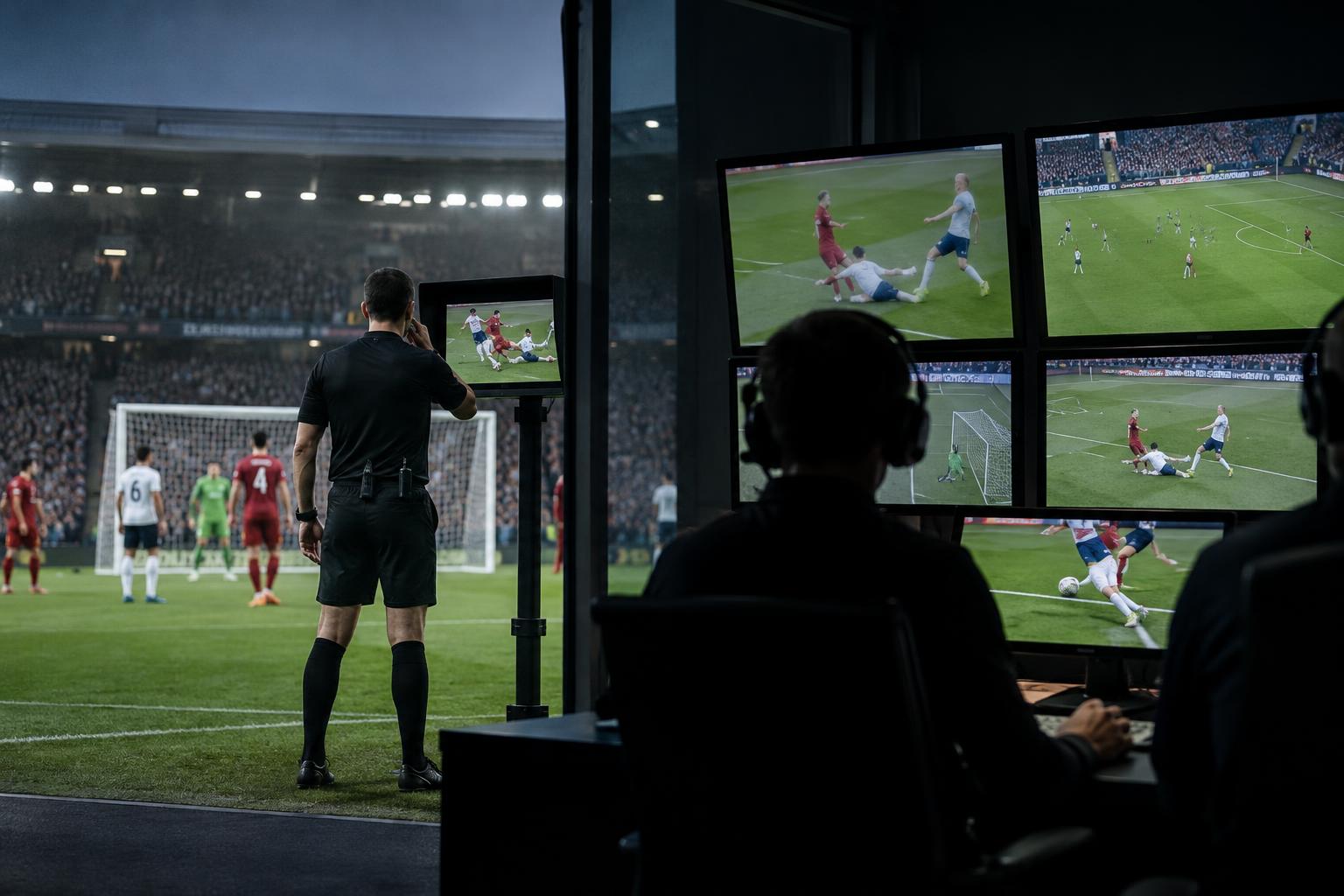
Every Premier League fixture has a Video Assistant Referee, supported by an Assistant VAR and a replay operator at the VAR Hub at Stockley Park in west London. Their appointments are announced by Professional Game Match Officials Limited, usually shortened to PGMOL. The team monitors the match using broadcast footage and different camera angles, communicating with the referee by headset. VAR arrived in the Premier League in 2019/20 after clubs voted unanimously for its introduction in November 2018. Its purpose was straightforward: give officials access to evidence that supporters could already see on television, rather than leave a major mistake untouched.
What can VAR check, and what is excluded?
The four categories are deliberately narrow. For goals, VAR checks whether the goal should stand, including relevant offences in the build-up, such as offside, handball, a foul or the ball leaving play. For penalties, it can examine both an awarded spot-kick and an incident where one might have been missed. Direct red-card checks cover possible sending-off offences, including serious foul play and violent conduct. Mistaken identity means correcting which player receives a yellow or red card. These are not four invitations to referee the whole game again; they are specific routes through which a significant mistake can be addressed.
Ordinary free-kick decisions, throw-ins and corners are outside that remit. Under the protocol described here, VAR does not review whether a second yellow card was deserved. It can, however, examine a challenge punished with a yellow if the issue is whether it actually warranted a direct red. That distinction matters: reviewing a potential straight red is different from reviewing a caution. Nor can VAR correct an incorrectly awarded corner simply because a goal follows it. The relevant attacking phase starts with the corner being taken, not the earlier decision to award it. A frustrating call can therefore remain uncorrected without VAR having overlooked its job.
How a VAR check becomes a review
The video team constantly monitors play and checks relevant incidents; players do not need to request this. A check is the examination of footage, not an automatic trip to the pitchside screen. The referee explains the original decision and what they saw, while VAR assesses the available angles. Real-time footage helps judge the intensity of a challenge; slow motion helps establish details such as the point of contact. If there is a possible qualifying error, the officials communicate and the referee can hold up the restart at the next stoppage. Many checks end with the original decision intact, without the referee going to the monitor.
For a subjective decision where VAR identifies a clear and obvious error, it recommends that the referee view the incident at the pitchside monitor, formally called the Referee Review Area. The referee then makes the final judgement, which need not be a reversal. Factual information can be communicated without a monitor visit. Before a goal or penalty is confirmed, checks can also cover the attacking possession phase: the immediate passage of attacking play that produced the incident. This is not permission to rewind indefinitely. Officials consider the attack’s momentum and whether the defence had an opportunity to reset, rather than automatically going back to the moment possession was first won.
What does ‘clear and obvious’ actually mean?
This is the most important distinction when watching VAR. On subjective calls, the question is not whether the video referee would personally have made a different decision. It is whether the on-field decision is clearly wrong on the available evidence. The Premier League calls this starting position the ‘Referee’s Call’, with a high threshold for intervention intended to preserve the game’s pace and intensity. Imagine a defender making contact with an attacker who then falls: footage showing contact does not, by itself, settle whether there was a foul. If the evidence does not establish a clear error, the original decision stands. That does not mean everyone must agree with it.
Factual decisions do not face that same threshold. Whether an attacker was in an offside position, whether the ball went out, or whether an established foul occurred inside rather than outside the penalty area can be corrected even when the margin is small. A marginal fact and a debatable judgement are therefore handled differently. Finally, players and coaches have no challenge system: demanding a check does not unlock one, and aggressively making the television-screen gesture can bring a booking. The useful viewing checklist is simple: is the incident reviewable, is the disputed point factual or subjective, and does the evidence justify changing the call? VAR provides more evidence, but football still asks human beings to interpret much of it.
More columns

Arsenal need perspective after Fleetwood, but not an excuse
Touchline Opinion
29 October 2026
How Many Games Are There in a Premier League Season?
Touchline Guides
28 October 2026

When did Arsenal last win the Premier League?
Touchline Guides
28 October 2026

When Did Leicester Win the Premier League?
Touchline Guides
28 October 2026