
Explore England’s biggest football stadiums, from Wembley and Old Trafford to Anfield, with capacities and an explanation of why rankings differ.
Wembley is the biggest football stadium in England, with a capacity of 90,000. Manchester United’s Old Trafford is the largest club ground, accommodating more than 74,000 spectators. Behind them comes a tightly packed group including Tottenham Hotspur Stadium, London Stadium and Anfield. The important distinction is between all football venues and club homes: Wembley tops the overall list, but usually disappears from rankings restricted to league clubs. Here, ‘biggest’ means spectator capacity for football, rather than pitch dimensions, the size of the building or the loudness of the crowd.
England’s largest football stadiums by capacity
 Advertisement · 18+ · Gamble responsibly · BeGambleAware.org
At the time of writing, the leading five in the supplied permitted-operating-capacity list are Wembley (90,000), Old Trafford (74,244), Tottenham Hotspur Stadium (62,850), London Stadium (62,500) and Anfield (61,276). Those venues represent England’s national teams, Manchester United, Tottenham Hotspur, West Ham United and Liverpool respectively. For a straightforward answer to the search, these are the headline names. Wembley is comfortably out in front, Old Trafford occupies a clear second place, and the next three are much closer together. Tottenham therefore has London’s biggest club stadium on these figures, but not the capital’s biggest football venue.
The next places need a little care. The same operating-capacity list puts Manchester City’s Etihad Stadium at 61,038, while other supplied guides give 55,097 or 53,400. Using the first figure places it ahead of Arsenal’s Emirates Stadium, listed at 60,704; the lower figures place it behind. Rather than pretend those sources agree, treat the Etihad’s precise position as something to check against the club’s latest information. The other grounds completing the leading group in the supplied lists are Everton Stadium in Liverpool (52,888), St James’ Park in Newcastle upon Tyne (52,305) and Sunderland’s Stadium of Light (49,000), all quoted at the time of writing.
Wembley and Old Trafford: two different answers
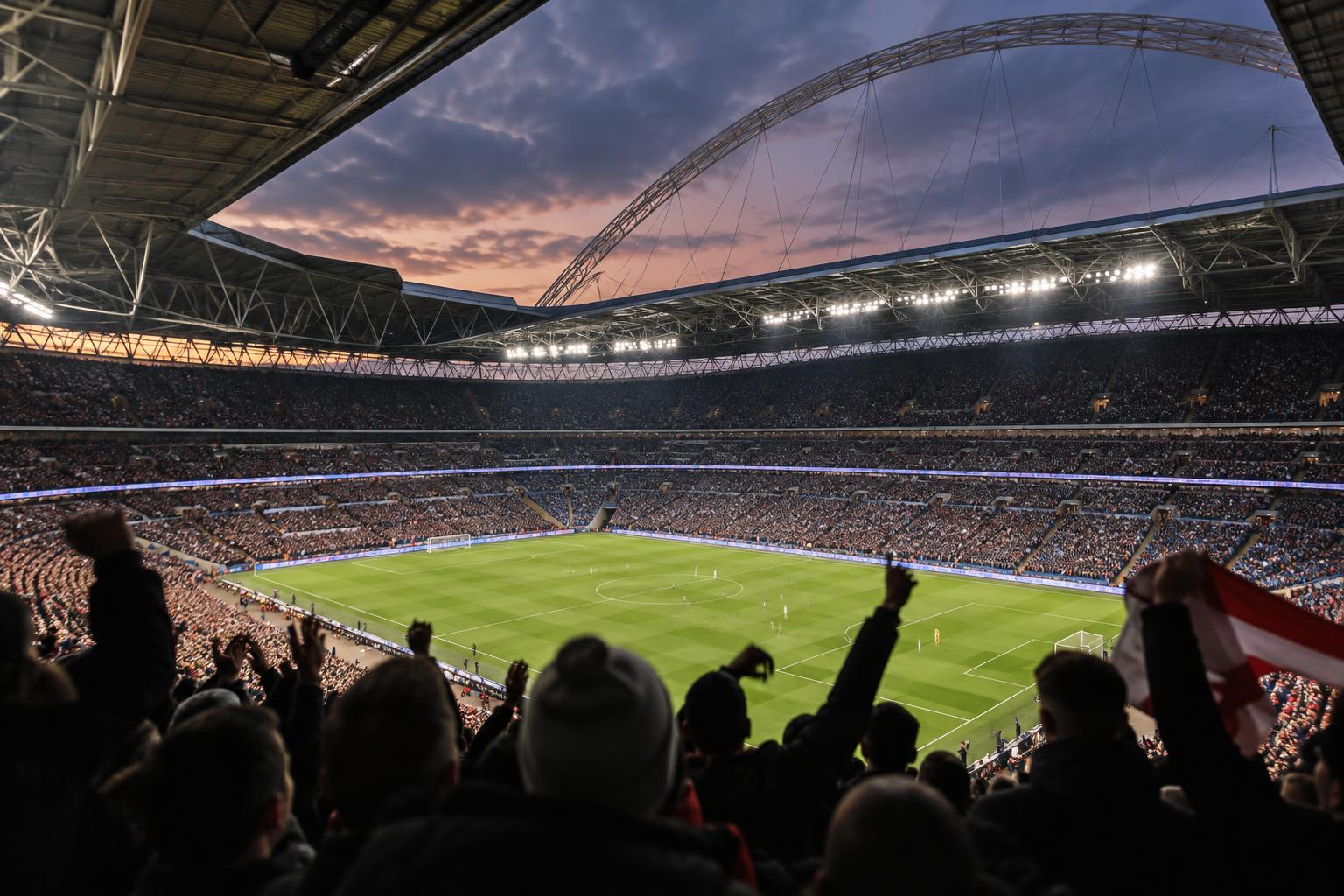
Wembley’s scale comes with a different job description from that of a regular club ground. The present stadium opened in 2007 on the site of the original Wembley, which staged the 1966 World Cup final. Its 133-metre arch provides the unmistakable outline, while England internationals and the FA Cup final give it a central place in the football calendar. It also accommodates concerts and other sporting events, but the relevant number here is its football capacity. If somebody asks for England’s biggest stadium without adding ‘club’, Wembley is the answer. Leaving it out would be answering a narrower question.
Old Trafford, opened in 1910, is the answer when that extra word is included. Its history of expansion and renovation has produced England’s largest club football ground, rather than a national venue used by different teams. Exact published capacities vary: the supplied sources quote 74,244, 74,310 and 74,879 at the time of writing. That disagreement does not alter its position above the other club grounds listed here. Manchester United announced plans for a 100,000-seat stadium in 2025, but an announced project is not an operating ground. Proposed seats should never be counted as though supporters can already sit in them.
What the capacity table cannot tell you
The biggest grounds offer quite different versions of a football afternoon. Tottenham’s stadium opened in April 2019, replacing White Hart Lane, and includes a 17,500-capacity single-tier South Stand: a useful reminder that the arrangement of supporters matters as well as their total number. London Stadium began as the venue for the 2012 Olympics and Paralympics before being reconfigured for its later role, including West Ham matches. Anfield, meanwhile, opened in 1884 and has been Liverpool’s home since the club’s foundation in 1892. Its modernisation, including expansion of the Main Stand, shows that a historic ground and a large modern capacity are not mutually exclusive.
Capacity tables also answer a different question from attendance records. Capacity describes how many spectators a venue can accommodate under the relevant arrangements; attendance describes the crowd for a particular event. The supplied England-wide list explicitly uses permitted operating capacity, which need not match a venue’s gross capacity. Nor should a concert configuration automatically be used to rank a football ground. These distinctions help explain why seemingly authoritative lists can disagree. Old Trafford’s competing figures and the wider spread of Etihad numbers are reasons to label the measurement carefully, not to choose whichever number makes the most impressive headline.
Geography is another easy trap. England is not interchangeable with Britain or the UK, so Scottish venues such as Celtic Park, Hampden Park and Ibrox do not belong in an England-only ranking. Equally, a list of grounds in the English league system is not necessarily a list of grounds physically in England: the supplied UK guide includes Cardiff City Stadium and Swansea.com Stadium in Wales. For this query, location is the deciding factor. That keeps the comparison consistent instead of quietly changing the rules halfway down the table.
If you are turning this list into a ground-hopping itinerary, use capacity as the starting point rather than the whole sales pitch. Check the club or venue’s current seating information before booking, then compare your actual block, view and access arrangements. More seats do not automatically mean a better atmosphere, an easier ticket purchase or a better view of the far touchline. Wembley delivers the biggest numerical spectacle; Old Trafford leads the club-ground comparison. Beyond those clear answers, the pleasure is in discovering how differently a huge crowd can feel from one stadium to the next.
More columns

Arsenal need perspective after Fleetwood, but not an excuse
Touchline Opinion
29 October 2026
How Many Games Are There in a Premier League Season?
Touchline Guides
28 October 2026
When did Arsenal last win the Premier League?
Touchline Guides
28 October 2026
When Did Leicester Win the Premier League?
Touchline Guides
28 October 2026
